The Real Axis

Worthy of real concern is the relationship between Venezuela’s dictator-in-development Hugo Chavez, Iran’s Ahmadinejad and the Hezbollah terrorist network, which has been reported to be basing itself in Venezuela to target anti-US operations.

hezbollah_in_venezuela

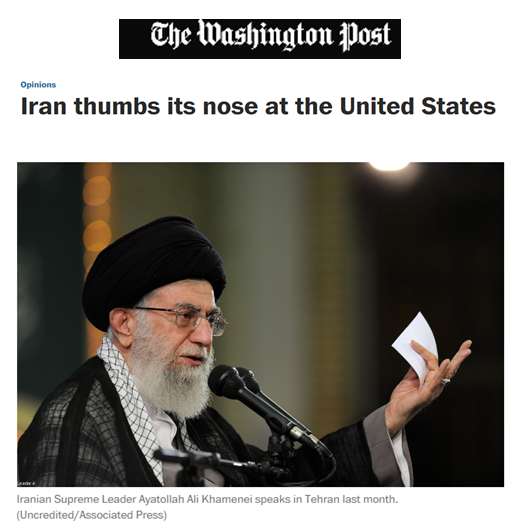
Noteworthy: Chief Iranian Ayatollah Praises Ahmadinejad

To the many well-intentioned Iran scholars who wistfully point out that Ahmedinajad’s rants can be discounted because true power lies in Ayatollah Ali Khamenei, the ‘Supreme Religious Leader,’ his recent defense of Ahmadinejad, including of his nuclear policy and confrontational style, should cause pause.

[Read more →]

Obama’s interview with the Jerusalem Post

Jerusalem Post Editor David Horovitz’s interview with Barack Obama is one of the most to-the-point expositions of Senator Barack Obama’s stances on Mideast issues.  Horovitz asked strong and straightforward questions, and Obama replied with earnest answers.  Anyone who truly cares about understanding the "real" Obama on these issues should read this interview.

One example:

Horovitz: You’ve said on this trip that you want to work for an Israeli-Palestinian accommodation from the minute you’re sworn in, so let me ask you about the thesis that there is no prospect of Palestinian moderation prevailing and enabling a peace process to really move forward until Iran’s nuclear drive has been thwarted - that so long as the Teheran-backed extremists of Hamas and so on feel that they are in the ascendant, the moderates can’t prevail and that the whole region is now in this kind of holding mode.

Obama: I think there is no doubt that there is a connection between Iran’s strengthening over the last couple of years, partly because some strategic errors have been made on the part of the West. And [the same goes for] the increasing boldness of Hizbullah and Hamas. But I don’t think that’s the only factor and criterion in the lack of progress.

Hamas’s victory in the [Palestinian Authority] election can partly be traced to a sense of frustration among the Palestinian people over how Fatah, over a relatively lengthy period of time, had failed to deliver basic services. I get a strong impression that [PA President Mahmoud] Abbas and [Prime Minister Salaam] Fayad are doing everything they can to address some of those systemic failures by the Palestinian Authority. The failures of Hamas in Gaza to deliver an improved quality of life for their people give pause to the Palestinians to think that pursuing that approach automatically assures greater benefits.

You know, look, I arrive at this with no illusions as to the difficulty in terms of what is required. But I think it’s important for us to keep working at it, frankly, because Israel’s security and peace in the region depend on it.

The Jerusalem Post Internet Edition

[Read more →]

Resistance Trumps Religion, in the Arab Middle East

If you are struggling to understand why Hezbollah leader Hassan Nasrallah and Iranian President Mahmoud Ahmadinejad, both Shiite, are so popular among Arab masses from Egypt to Palestine and Saudi Arabia, where the predominant religion is Sunni, think of it through a different prism: the culture of Resistance.

The culture of Resistance trumps the schisms of religion, as well as other divisions like nationality, ethnicity, and political persuasion.

The Arab world has been so impregnated with an anti-West, anti-colonialist, anti-occupation, anti-invasion, anti-globalization, anti-Israel ethos, that anything or anyone who stands at the vanguard against these modern suppressors will be greeted with enthusiasm.

The challenge for the good of the Arab Middle East and the world at large is how to channel all of these very real frustrations, that have only been deepened by lack of political accountability and continued authoritarian rule seen as imposed by the West on the Arab population, into a constructive path for progress within the Arab Middle East and outside.

It is not an easy challenge to overcome.  If anyone figures it out, they will hold the key to progress and popularity.

At present, you either drive for revolution and cry against oppression in the name of "resistance", or you are part of the establishment and hence seen with suspicion by ordinary Arabs that are not part of the elite.

Great leaders like Palestinian Prime Minister Fayyad or Jordanian King Abdullah, who are bringing economic progress to the poor in their country, will have difficulty getting credit, because they are seen as agents of the West.

Democracy and other concepts that should ordinarily appeal to the human quest for freedom similarly have difficulty because they are seen as Western impositions, and part of a cultural colonization.

Reality Check on Iran

Can policy makers and strategists be really so naive?

The Ahmedinejad regime has turned Iran’s right to nuclear development into a national mantra.  Only its Islamic fundamentalism and its ideology of spreading their revolution stand above their nuclear ambition.

And yet diplomats seem to think they can sway Iran into a set of incentives to cease its nuclearization path?

The Iranians have made it all too apparent that they use the negotiations as a way to stall and buy time, to the point of embarrassing the negotiators, as an excellent article from Elaine Sciolino of the New York Times painfully pointed out. 

Studies from Iran "appear to show as yet undisclosed uranium-related work, high-explosive testing of triggers for nuclear bombs, a plan for an underground nuclear-test shaft and efforts to redesign the nose-cone of Iran’s far-flying Shahab-3 rocket to accommodate a nuclear warhead."

And yet Fareed Zakaria, who is otherwise a pretty smart guy, seems to assume on his TV show that these negotiations have a chance to work.  How? 

Nobody points out the foolishness of trying to get Iran to stop its nuclear race.  Condoleezza Rice says Iran is vulnerable on its nuclear ambitions.  Otherwise smart Senator Biden, chair of the US Senate Foreign Relations Committee, writes an op-ed encouraging pressure to change Iran’s behavior and give up weapons. What are these people thinking?!

No amount of sticks or carrots will make Iran drop its nuclear plans.  At best, like with North Korea, the West can play a game that will slightly slow down the regime’s path, and it can certainly extract a high cost for Iran’s efforts, isolating and weakening it.

But the only true path to end Iran’s drive to acquire nuclear weapons is for the government to change.  If policymakers can’t stomach that undertaking, they should just accept and brace themselves for a nuclear Iran.

What are the options?

  • Regime Change
  • accept inevitability of Iranian regime working to develop nuclear weapons but make it very painful to the point that regime will be unpopular enough to fall
  • Military attacks and counterinsurgency (applied in the same manner that Iranians do in Iraq, Lebanon and Palestine) to undermine the Iranian regime

What is not in the cards is to expect this regime to drop its quest for nuclear weapons, overtly or covertly!

[Read more →]

Addressing the Root of the Iranian Threat

I got the following email from Ziad Abdelnour, President of the US Committee for a Free Lebanon.  Ziad was born in Lebanon, and he does not parse any words.  While sometimes he is rough and undiplomatic, his clarity is necessary at times of politically correct ambiguity, as we’ve witnessed when addressing Iran and its quest to acquire nuclear weapons. 

Anyone who truly thinks the West can actually "negotiate" to get the Iranian regime to relinquish its quest is deluding themselves and has not been listening to what the Iranian Ayatollahs have been telling their people.  They play the West like a violin with embarassing protracted games designed to buy time, which is in their favor. 

The observation that you can pursue regime change or nuclear containment, but not both, is probably true.  But what is uncomfortable to face is the reality that the later is unlikely to yield any results.  Below is Ziad’s letter:

With or Without Nukes, Iran and its proxies Syria and Hizballah are a Mortal Threat

As President Bush’s term is coming to a close, Lebanon’s survival as a multi-ethnic, multi-denominational state is more than ever at stake.

Iran and Syria are quickly changing the balance of power in the Eastern Mediterranean, while the West and moderate Arab states appear almost paralyzed and the Lebanese State is nowhere to behave like a sovereign country but a province of Syria and Iran.  All what the Lebanese are concerned about nowadays is how much fun and how many tourists they will host this summer rather than ruthlessly dealing with the total political and economic chaos the country is facing; threatening its very existence.

BUT…. this is not about Lebanon, but about the U.S. presence in the Middle East, its diplomacy, and its allies.

Ever since taking the U.S. embassy staff hostage in 1979, the Islamist regime in Teheran has led an international spree of bombings, hijackings, and other terrorist attacks on Americans and Westerners. Now politicians and diplomats, who put up with Iranian aggression for years, are loudly promising to block Iran’s pursuit of nuclear weapons.

On the campaign trail, for instance, our Presidential candidates debate how (i.e., with or without preconditions) they’d negotiate to dissuade Iran from pursuing a nuke–on the idea that without such a weapon in Iranian hands, everything will be hunky-dory.

A rational assessment of Iran would have to recognize that the mullahs in Teheran have been conducting a proxy war against America for at least a few decades. The inspiration for this war is Iran’s jihadist goal of imposing Islamic totalitarianism globally. Iran is a leading sponsor of jihadists and the self-identified role model for exporting its Islamic revolution to other countries. It is the sworn enemy of the West. We should take seriously its call to bring "Death to America!"–because it has already done so.

BUT….also in here, too many American diplomats and commentators refuse to judge Iran. Instead, they regard its past hostility as a string of disconnected crises, unrelated to Iran’s ideological agenda. They avoid naming the nature of the regime and behave as if its acquisition of a nuclear weapon would be the decisive event. But that particular weapon–despite its power–cannot be the whole story, since we don’t worry about other countries, such as France and Britain, having nukes. The rarely admitted difference is that the regime in Iran would eagerly press the launch button.

This fear-the-weapon-not-the-killer mentality refuses to understand the threat posed by Iran right now. This view holds that only the concrete facts about Iran’s arsenal have any practical significance, while its abstract, ideological goals and character can be disregarded with impunity. But whether Iran uses one nuke, or attacks with more conventional weapons, its victims are still dead.

Our leaders’ narrow concern with Iran’s nuclear capability cannot make the regime’s longstanding hostility to America go away. Americans should face the real character and conduct of the Iranian regime, before it is too late.

The United States must recognize that America does still have allies in the Middle East, especially when it comes to containing Iran. Saudi Arabia, the Sunni Arab Gulf states, as well as our European allies all understand what is at stake. Yet, to pursue a policy of Iran containment, the United States must make it clear that it will stand by its allies.

Washington therefore should immediately:

·     Design and implement a comprehensive policy that includes military, covert, economic, diplomatic, and public diplomacy components to decisively and quickly weaken and roll back Iran and Syria. They have assets and interests that can be frozen or confiscated. They also have officials and businessmen who travel throughout the world and should not be welcome anywhere as long as their policies remain disruptive in Lebanon, Iraq, Gaza, and elsewhere. Any Lebanese, Syrian and Iranian officials or entity involved in financing, training, supplying, and facilitating terrorism, and specifically Hezbollah, should be placed on the visa boycott list starting with Bashar Assad and Mahmoud Ahmadinejad. 

· Work with the European allies so that they declare Hezbollah a terrorist organization, put it on the EU terrorism list, and freeze their economic activities, fundraising, and financial assets throughout Europe, the Middle East, and around the world. Adding Hezbollah to the EU terrorism list would also be an important step toward disarming its militia and restoring the rule of law in Lebanon. Hezbollah enjoys Iranian subsidies and Syrian arms supply. However, Hezbollah is allowed to operate openly, including fundraising and profitable businesses in Europe. This must stop immediately. The State Department and anti-terror arms of the United States and Arab states need to work with the Europeans to ban Hezbollah’s activities on the continent.

· Halt whatever it takes arms shipments and spare part supplies to Hezbollah’s TV and radio channels, telecommunications, businesses, and vehicles. These supplies originate in Europe, the U.S., Japan, and other Far Eastern locations, and are shipped through Beirut and the Gulf. The U.S. should initiate a drastic and concerted effort to stop military re-supply of Hezbollah. The United Nations should be urged to do a better job implementing Resolution 1701, which envisages disarmament of all Lebanese militias, including Hezbollah, and halts the arms supply to it, especially by Iran and Syria. The U.S. should also work with allies in the Middle East and Europe to halt non-military supplies to Hezbollah’s businesses and telecommunications operations.

Time to act is of the essence. Time to dismantle Iran and its proxies is a must…no matter what. This circus has got to stop right now….Enough is enough.

Your support towards this critical cause is always greatly appreciated

Respectfully,

Ziad K. Abdelnour

President

US Committee for a Free Lebanon

Human Conscience at the expense of strategic stupidity, or a major impending breakthrough in the workings? The Mystery of the "Release of Missing Israeli Captives"

The Israeli Government has just announced its agreement to procure the "release" Ehud Goldwasser and Eldad Regev, the two Israeli soldiers abducted by Hezbollah in the summer of 2006, in exchange for releasing several Lebanese prisoners including Samir Kuntar, the man who in 1979 murdered 3 Israelis in their home, including a 4-year old, and who caused the hiding mother to suffocate her 2-year-old daughter as she tried to quiet her crying.

What is the problem?

  • Sheikh Nasrallah ordered the attacks and incursions that brought about the Hezbollah-Israel war in 2006 with the stated goal of releasing Kuntar; Nasrallah outlined how he would capture Israeli soldiers to use as bargaining chips to bring about the release of Kuntar; now, 2 years after such devastating war and a month after having turned his guns on Lebanese people that supported the Lebanese government, he is being rewarded;
  • Goldwasser and Regev are apparently dead, so the Israeli government is inviting terrorists not just to try to capture Israeli soldiers, but to kill them if they so please, as Israel will be willing to exchange their bodies anyway, for precisely the objectives that terrorists wish to attain.

I feel horrible for the families that lost Ehud and Eldad. But besides the perverse and ominous incentives this deal creates, it is also going to turn Hezbollah’s Nasrallah from a formidable hero into a mythic legend in the eyes of many in the Arab world.

The timing is particularly regrettable because for the first time in 20+ years, Nasrallah had lost a little of his luster when he showed his color and attacked fellow Lebanese civilians.  This will restore his stature and more.

Unless there is a secret grand bargain in the making that, with Lebanese/Shaba farms, Syrian, and Palestinian negotiations will settle the Israeli-Arab conflict and distance Israel’s neighbors from Iran, today is as tragic a day for civil society as it is a cause for celebration for those who espouse violence as a tool for political leverage.

Below is the text of the Israeli government’s outline for the agreement on releasing the abducted soldiers in Lebanon:

[Read more →]

A Respite for National Interests Above Petty Politics in Israel

This article from the Christian Science Monitor summarizes pretty well the political developments that have for now kept the current Israeli parliamentary coalition afloat.

Instead of recriminations and fights for personal political advancement, for once these considerations were borne in mind:

…it’s not as if we don’t have a few other things to keep us busy… …Israel’s shaky truce with Hamas, which is just six days old and already being tested by militants who fired rockets into Israel Tuesday; possible negotiations with Hezbollah over Israel’s captured soldiers; indirect talks with Syria; and nuclear tensions with Iran.

…not to mention the little detail about Olmert’s commitment to achieve a framework agreement with Abbas within 2008.

[Read more →]

To Speak to The Enemy?

Gerald Seib wrote a straightforward, clear, and to-the-point column in the Wall Street Journal on the "would you meet with leaders of rogue states" question haunting Barack Obama - using Israeli Prime Minister Ehud Olmert’s approach towards Syria as a very good example of how to do things.

[Read more →]

The Two Middle Easts

From apocalyptic threats by the Iranian regime’s President, Mahmoud Ahmadinejad, to introspective and semi-neurotic analyses from Jewish supporters of Israel, you would think that Israel’s very existence is truly in danger.

It is absolutely the case that Iran’s nuclear efforts coupled with its on-the-record threats to erase Israel of the map of the world need to be taken seriously and that the world - and Israel - must rise to the challenge posed by the Iranian Ayatollahs’ vision of absolute and violent Islamic revolution.

It is also absolutely the case that the window of opportunity for a two-state-agreement gets smaller by the day, and that not seizing it when it’s available will be a tragedy for both the Palestinian and Israeli people because it will enslave them to eternal warfare and limit their potential.

But read Tom Friedman’s article, People Vs. Dinosaurs, to get a feel for why Israel is not just not "disappearing" as Ahmadinejad claims, but why it is going to continue to thrive and grow.  Some excerpts:

[I]n the first quarter of 2008, the top four economies after America in attracting venture capital for start-ups were: Europe $1.53 billion, China $719 million, Israel $572 million and India $99 million, according to Dow Jones VentureSource. Israel, with 7 million people, attracted almost as much as China, with 1.3 billion.

Boaz Golany, who heads engineering at the Technion, Israel’s M.I.T., told me: “In the last eight months, we have had delegations from I.B.M., General Motors, Procter & Gamble and Wal-Mart visiting our campus. They are all looking to develop R & D centers in Israel.”

Ahmadinejad professes not to care about such things. He was — to put it in American baseball terms — born on third base and thinks he hit a triple. Because oil prices have gone up to nearly $140 a barrel, he feels relaxed predicting that Israel will disappear, while Iran maintains a welfare state — with more than 10 percent unemployment.

Iran has invented nothing of importance since the Islamic Revolution, which is a shame. Historically, Iranians have been a dynamic and inventive people — one only need look at the richness of Persian civilization to see that. But the Islamic regime there today does not trust its people and will not empower them as individuals.

…Iran’s economic and military clout today is largely dependent on extracting oil from the ground. Israel’s economic and military power today is entirely dependent on extracting intelligence from its people. Israel’s economic power is endlessly renewable. Iran’s is a dwindling resource based on fossil fuels made from dead dinosaurs.

Then peruse some of the newspaper editorials and op-ed pieces in Lebanon, Syria and Iran and you will get an idea of the obscurant and sad repression against the human spirit that bad governance is provoking.

[Read more →]